A more important “About” page for me is located here.
I’m a physicist by education*, but as enthralled by ornithology as by quantum field theory. (I am also becoming obsessed with dragonflies…) For over 30 years, I’ve been gripped by a compulsion to see or hear as many species of little plumed dinosaurs as is humanly possible. I’m also fascinated by how they do what they do, and with the means by which we can enjoy them.
To that end, I’ve spent the last several years writing a detailed, non-specialist account of how these interests overlap: my book The Physics of Birds and Birding, published by Pelagic Publishing on May 20, 2025.
I am also legally blind, due to retinitis pigmentosa (RP), a group of a genetic diseases which destroy retinal rod cells, resulting in the loss of night and peripheral vision.
This is not exactly optimal for birding.
To lose night vision isn’t simply to not see in the dark. Even low-light conditions, such as in a dimly lit forest, for example, can be like having no light at all. Twilight might as well be midnight.
As for the loss of peripheral vision, try the following. Extend an arm, straight ahead, palm up, fingers together – as if someone was to place something in your hand. Focus on the tip of your pinky. Now wiggle your thumb up and down while still looking at that little finger. You will see your thumb moving, as well as other things further to that side of your hand. When I do this, I see my pinky and the other fingers, but I cannot see my thumb, or anything else off to the sides, or above, or below.
This constriction is sometimes called ‘tunnel vision’ and is quantifiable in terms of visual field width, which for healthy eyesight would be a bit under 180 degrees from one side to the other. My visual field is less than 15 degrees wide. Such a narrow range is one way in which legal blindness is defined. I am fortunate that I am not totally blind, but trust me, tunnel vision is not fun. You would not like it. Especially when you are trying to see birds.
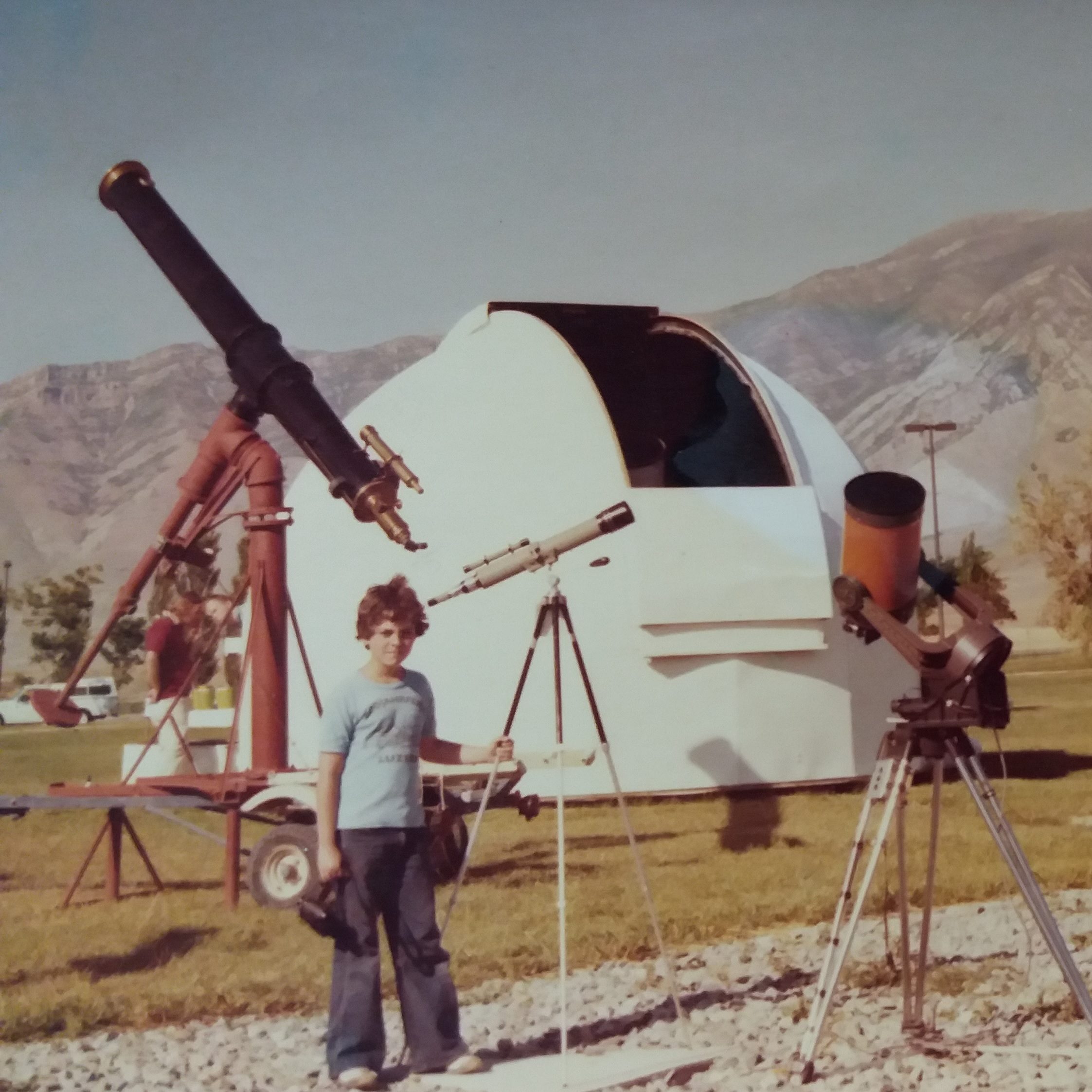
My eyesight was once good. At age twelve, I discovered stars and planets and was a devoted member of the Salt Lake Astronomical Society:
In college, I traded gazing at stars for staring at physics textbooks. Studying at a park one afternoon when I was working on my doctorate, I saw a woodpecker feeding on the ground. I don’t know why, but I needed to know what it was called. I headed directly to a bookstore, bought a Peterson Guide, and learned that Colaptes auratus would be my instigator bird. Several months later, I would meet a lovely wildlife biology graduate student named Claire. On our second or third date she would mention, offhand, that she’d spent the afternoon out birding (birding! there was a word for it!) with the local Audubon group. I knew then that I would have to marry her.
Within a year of these happy events, my vision began to rapidly fail. RP makes birding much more difficult – sometimes impossible, and often damn frustrating. I’ve been tempted more than once to throw down my binoculars and give it up. But I set a goal to be the most prolific legally blind birder in the world, and to surpass at least 99% of birders that have no disabilities… just to demonstrate that it could be done. As of December 2025, I have 5,052 species on my life list, and according to eBird rankings, I’m above the 99.97th percentile for all birders. So, mission accomplished, I guess.
Of course, few people care about this, just as few people care about anyone’s life list except their own. That is a paradox of birding: one can spend so much time and money traveling the world to accumulate a big tally of species, and… so what? As I began to realize this I became less interested in the narcissistic side of birding, and more drawn to contribute somthing of value, such as my book, or to write detailed accounts of the physics phenomena associated with birding equipment, such as described here and here.
Meanwhile, I have moved on to something far more important than chasing birds and counts: I teach Physics, Chemistry, Statistics, and Algebra courses at a wonderful Catholic high school here in the Twin Cities. I became a Catholic in September 2024, after four decades of militant atheism, and I am thrilled to use my education and teaching talents to help the next generation of the faithful to be succesful, so that they will be better prepared to spread the message of Truth, Love, and Beauty in an ugly secular world that needs God more than ever.
* I earned my PhD in physics from Colorado State University in 1996. My work has focused on magnetic excitations in solids, including spin waves and magnetostatic waves; ferromagnetic resonance and loss mechanisms that involve scattering from inhomogeneities in both bulk and thin film materials; spin-stand characterization of magnetic recording systems for noise and distortion; written track microscopy techniques; and digital signal processing such as that used in high data-rate Viterbi channels.
Academia.edu page with my publications.
