We must have bought this game back in 1993 or 1994. You cannot find it anymore, except on eBay. The date on the box is 1990… 35 years ago! The passage of time certainly seems to accelerate as you get older. It was called The Birding Game with Roger Tory Peterson.
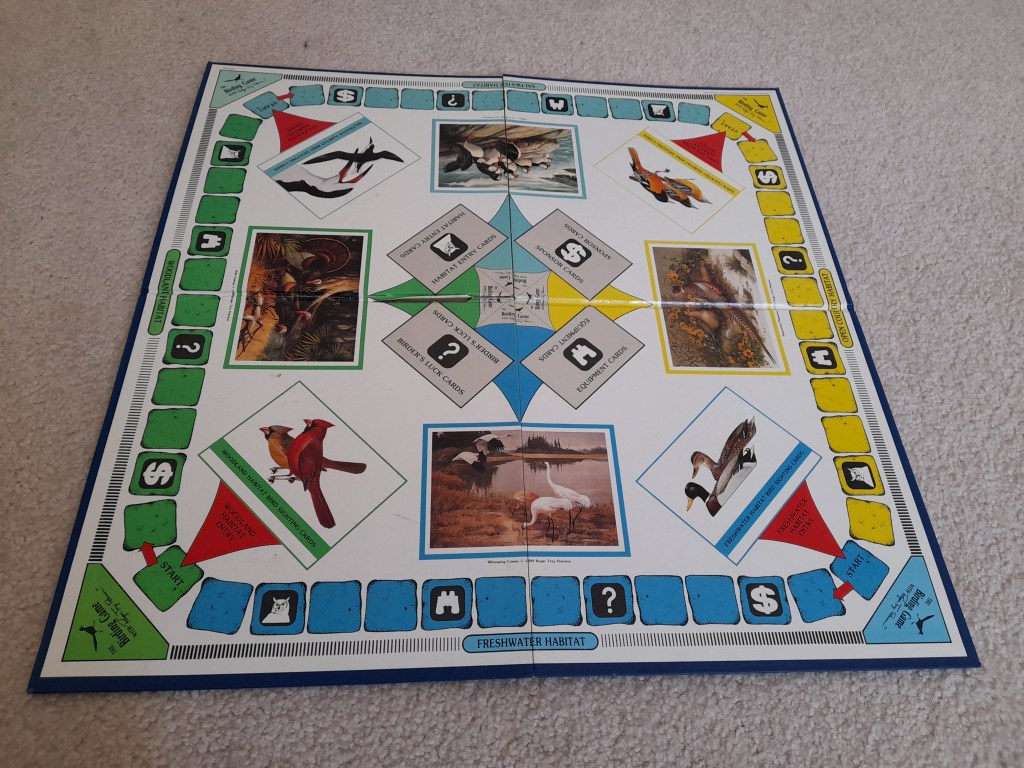
It was very much a Monopoly-style board game, in which one had owl-shaped pieces that were moved around the periphery of the board, based on the outcome of rolling dice. But you accrued points based on: (a) your ability to identify North American birds; and (b) your knowledge of related bird trivia.

There were several other elements involved: you collected equipment by drawing from a deck of cards, and the points you collected depended on pledges, again determined by random draw from a stack of cards. The game was intended to emulate a fund-raising Big Day or Birdathon.
I have had no desire to play this since we broke it out a few times shortly after buying it. It does not teach one to identify anything. That was never its purpose, and in any case, North American birds became etched into my mind very rapidly as we travelled from Florida to Alaska during our first few years together, a dry run for our later treks from Iceland to Antarctica and every continent in between. What I had wanted, in order to prepare for those trips, was a birding game that would teach me the species we’d need to learn.
Such things do not exist, unless you want to construct them. And we found a useful engine for doing this, in the form of Anki.
Anki is a free, highly configurable program which allows for the quick and easy construction of digital flashcards. It also has a playback system that allows you to see one side (with, say, the image of a bird) for as long as you need as you try to recall its name. After then ‘flipping the card over’ you can score how you did: was it easy, medium, hard? The beauty of the software is that it will use your rankings so as to show you the more difficult cards more frequently in the future, until they become more familiar, and you then rank them lower and move on to new ones.
This program is a godsend for learning anything, in fact. When I began my formal study of Spanish many years ago, it was integral to building vocabulary. And the other critical feature for me is that the top side of the card need not be palabras en español or the image of a bird: it can also be a short MP3 file. Months before a trip to a new international locale, I would create a deck with calls and songs of our target species, and train myself to recognize as many as I could. It is far more joyful to hear the song of some furnariid or antbird and know what it is, than to record it and work it out later (although I have had to do that many times).
My latest Anki deck, which my wife and I ‘play with’ every day, involves those other ‘birds’. You know, the ones that don’t sing, that are very small, and only fly in the summer. I’m speaking of dragonflies, which have come to obsess us in the same way that birds always have. These are far more challenging for me since I cannot employ my ears for identification, which is my primary birding method. So with odonates, I’m very reliant on my wife to find these little animals and get them lined up into the narrow tunnels of my vision, so that I can attempt to get my Nikon P1000 pointed at them. With patience it is feasible. Last Christmas she bought me a net. I expect my attempts to use it will be comical.
For my first dragonfly Anki deck, I scanned and edited images from Ed Lam’s new, wonderful field guide, Dragonflies of North America. I removed all the text from each image, placed it on one side, and put the name on the other.

We have been keyed in on only those species we can find here in Minnesota, and by the time they start flying in a few months, we should have our ID skills in a much better place than we would have been without the flashcards.