“Tradition is not the worship of ashes, but the preservation of fire.”― Gustav Mahler
Imagine that it is an autumn day in Manhattan, the year is 1869, and a huge party is taking place. You might learn from others in the crowd ― if you hadn’t been reading the papers ― that similar festivals were happening across the country.
It is the 14th of September. Has some war just ended? Perhaps a great railroad has been completed, and the occasion is being marked? Or is it a president’s birthday?
The jubilation does in fact commemorate a birthday, but not that of a politician, nor of any American, for that matter. The honoree was born in Berlin, and only once set foot in the United States, briefly, around the turn of the century. He died in 1859, and today is the 100th anniversary of his birth.
Ten years gone, and he is still such a rock star that here in New York, his portraits are paraded through the streets prior to the main event, the unveiling of his bust in Central Park.
Manhattan might be hosting the biggest blowout, with the rest of the United States following its lead, but celebrations of thanks for this one man are in fact taking place in cities around the world.
Having conjured up this scene, let’s take a step back. It is difficult to imagine anything like it happening today. It is all but impossible to imagine it happening for a scientist. But it did.
This festival was in honor of Alexander von Humboldt.
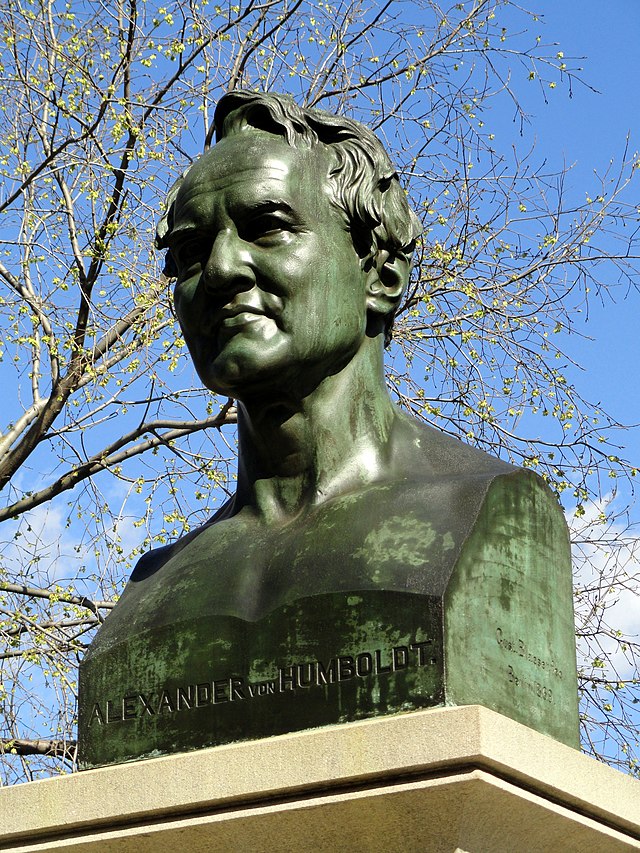
Few today recognize Humboldt or know of his exploits, even though there are more places around the world named in his honor than for any other person. Curiosity about historical namesakes has become curiously attenuated. Fewer still know how he transcended boundaries and, for a time, seemed to inspire everyone that heard his story.
Henry David Thoreau’s Walden was a reply to him.
Edgar Allen Poe dedicated poetry to him.
His own writing reveals a deep reverence both for nature and for our collective enterprise of discovering how it works. He wrote for a broad readership – not just a specialized audience of peers – establishing a tradition carried on by the likes of Carl Sagan and Stephen Jay Gould. He understood the importance of traveler’s tales for stoking the curiosity of coming generations.
He was perhaps the first scientist to warn that oblivious humans could destroy entire ecosystems. He is widely regarded as a founder (if not the founder) of environmentalism.
His scholarly contributions were immense.
You can peruse his seemingly endless Wikipedia entry to gain an idea of the breadth and depth of his career. Better yet, you can read Andrea Wulf’s wonderful biography, The Invention of Nature: Alexander von Humboldt’s New World. (There you will also find a fuller description of the events of September 14, 1869.) Wulf also wrote a lovely piece for The Atlantic which provides a fine introduction (link).
Wulf is a thorough biographer, but with so many accomplishments to cover, she omits what we in the physical sciences might argue was the explorer/scientist’s crowning work. In 1804, together with the French chemist Joseph Louis Gay-Lussac, he performed the first experimental demonstration that established the composition of water as two parts hydrogen to one part oxygen.
“With the name of Humboldt,” said ornithologist William MacGillivray, “we associate all that is interesting in the physical sciences.”
Today, when his name comes to mind, it is often in the context of the ocean current which flows up along the west coast of South America. On that continent, where so much of his work occurred, he was even more prolific in contributing to the life sciences. He completed accounts for over 100 animal species, and nearly 300 plant species bear his moniker.
Two birds commemorate him with an honorific: the Humboldt Penguin (Spheniscus humboldti) and Humboldt’s Sapphire (Hylocharis humboldtii).

One last bit of trivia: when it was admitted to the Union in 1864, the state of Nevada was nearly named Humboldt instead. If only! It would have been a pittance in exchange for the gifts that this genius gave the world.
Every time I encounter the likes of such men and women, I’m reminded of the importance and power of simple gratitude. There is never enough of it, and we all need frequent reminders to exercise it – which is why a society that aspires to be enlightened and gracious must raise high the statues of its heroes.