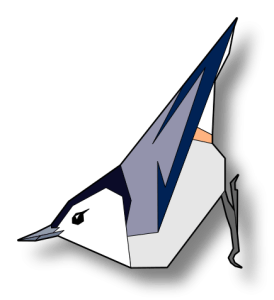
Pelagic Publishing, based in the UK, is set to release my book, The Physics of Birds and Birding, on May 20. Here’s the Table of Contents:
Preface : Looking Up
1 At the Feeder: Birds, Mathematics and Symmetry
2 In the Garden: Hummingbirds, Flowers and Forces
3 On the Open Seas: Length Scales, Migration and Molecules
4 In a City Park: Movement, Murmuration and Magnetism
5 By a Forest Pond: Impacts, Waves and Sounds
6 Under Night’s Cover: Hearing, Recording and Analyzing Birdsong
7 At the Lake: Sunlight, Reflection and Refraction
8 During a Big Day: Light, Matter and Feather Colors
9 In the Blind: Images, Eyes and Cameras
10 From a Great Distance: Lenses, Binoculars and Scopes
11 Under Extremes: Heat, Cold and Thermoregulation
12 Above the Earth: Wings, Lift and Flight
Coda: Looking Back
The original subtitle was “The Sounds, Colors and Movements of Birds, Our Tools for Watching Them, and the Underlying Unity of Nature.” A tad too wordy, so it was trimmed down a bit. Being a physicist first and a birder second, I wanted to stress that the world of birding is simply another way (a most lovely way) to see how everything around us is built up from the same elegant set of mathematical laws.
The idea for this text goes back to 2018, when my wife and I were doing a “Working Big Year” based out of Bangkok. When we were not at our full-time jobs, we were traveling in Asia, Africa, and Australia, attempting to see how many species we could rack up—we didn’t have the means to do a full-blown, 365-days-of-birdng, global Big Year that some people have the resources to manage. It was utterly exhausting and I thought a lot about my next “birding project” being something quite different, something that others might benefit from: a book that would attempt to tackle a vast array of topics that reside where biology and physics overlap. A book that allowed me to tie my avian obsessions back to my formal education.
This writing project, however, was no less exhausting. Starting in 2019 we cut back on global trips, leaving more time for this work. I lost track of the number of revisions, but I can say that the final product is probably only a third of what I had originally envisioned. One thing that means is that I’ve got other, more involved topics to write about here. I’ve already got a head start on that, having treated various optics and acoustics topics in a lot more technical depth (and with animations) than what the book would allow. (See here and here, for example.)
Initial Reviews:
“Avian aerodynamics, birding beam widths, corvid calculus, duck dynamics — Hurben takes us through the alphabet of physics on the wings of birds. I am a physicist and lifelong birder, and have learned a lot about both from this extraordinary and engaging book.” —Dr. Mark Denny, author of Long Hops: Making Sense of Bird Migration
“Hurben takes the science of physics to a whole new dimension with his book that ties physics to the birds around us.” —Carrol Henderson, author of Birds in Flight: The Art and Science of How Birds Fly