Initial Reviews of my Book: Many Good, One Rather Inexplicable

So I’ve had some very nice reviews of my book, The Physics of Birds and Birding. I am very grateful for these, and they have been coming from birding organizations, birders, bloggers, and several ornithology journals. On a recent podcast, the American Birding Association had three reviewers good through their top five birding books of … More Initial Reviews of my Book: Many Good, One Rather Inexplicable

Errata, Some Fractals and Musings on Mandelbrot

I just found a small math error in my book. How annoying and frustrating. It is subtle and not something that most people would ever notice or care about, but before some astute, mathematically-inclined reader points it out, I want to provide the correction here. It doesn’t impact anything substantive I say in the book, … More Errata, Some Fractals and Musings on Mandelbrot

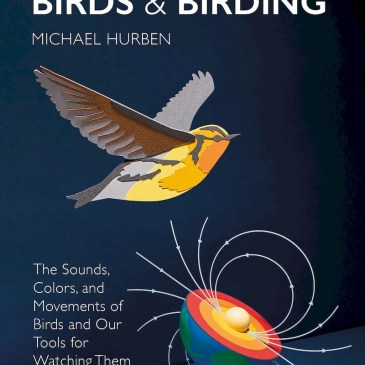
The Physics of Birds and Birding: The Sounds, Colors and Movements of Birds, and Our Tools for Watching Them

Pelagic Publishing, based in the UK, is set to release my book, The Physics of Birds and Birding, on May 20. Here’s the Table of Contents: Preface : Looking Up1 At the Feeder: Birds, Mathematics and Symmetry2 In the Garden: Hummingbirds, Flowers and Forces3 On the Open Seas: Length Scales, Migration and Molecules4 In a … More The Physics of Birds and Birding: The Sounds, Colors and Movements of Birds, and Our Tools for Watching Them

Anti-Reflection Coatings Part III: Oblique Incidence

Dealing with Non-normal Incidence In the previous post we developed the TMM for the special case of light incident in a direction perpendicular onto a multilayer coating. And as developed in the post before that, our treatment of the reflection and transmission coefficients required nothing more complicated than some commonsense assumptions about the behavior of … More Anti-Reflection Coatings Part III: Oblique Incidence

Anti-Reflection Coatings Part II: The Transfer Matrix Method

The Headache of Multiple Layers In the previous post we calculated the effect of a single dielectric layer placed between air and glass, and showed that with a judicious selection of index and thickness, it would serve as an anti-reflection coating that would pass 100% of the light at a nominal wavelength, and at least … More Anti-Reflection Coatings Part II: The Transfer Matrix Method

Anti-Reflection Coatings, Part I: Single Layer

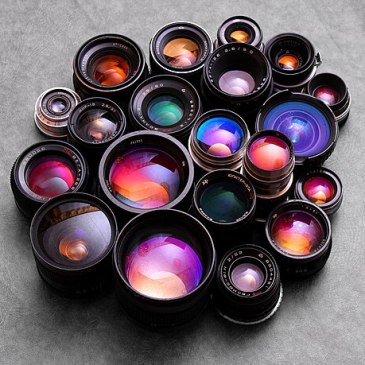
Introduction It is well-known that the transmission of light through optical components such as lenses and prisms can be improved through the application of specialized dielectric coatings. We’ve come to take them for granted, and can easily forget that without them, the views through our instruments would be significantly dimmer. Any curious user of binoculars, … More Anti-Reflection Coatings, Part I: Single Layer

Technical References for Roof Prism Resolution Loss, Phase Coatings, and Related Topics

This page is meant to provide a list of references that are directly relevant (marked with a *) or in some cases marginally relevant to the topic of resolution loss in roof prisms and the so-called phase coatings used to mitigate the problem. If you know of any additional literature, please email me at hurbenm … More Technical References for Roof Prism Resolution Loss, Phase Coatings, and Related Topics

On the Passage of Linearly Polarized Light through an Uncoated Roof Prism

The famous Zeiss “paper” by Weruach and Dörband (translation attached below) on the development of phase coatings for roof prisms describes a simple test to determine if an optical instrument has coated prisms or not. They describe the use of two linear polarizers with the device placed in between; with phase coating present, one will … More On the Passage of Linearly Polarized Light through an Uncoated Roof Prism

The Physics of Roof Prism and Phase Coatings, Simplified: Polarization Effects

Many binoculars utilize roof prisms to keep the light along a single optical axis, making for a more compact shape. But the novel geometry of the prism’s reflecting surfaces creates a subtle interference effect which reduces the binocular’s resolution. The only way to mitigate this problem is to use specialized coatings on the roof surfaces. … More The Physics of Roof Prism and Phase Coatings, Simplified: Polarization Effects

Un-bird-end by What has Bin: No More eBird for this Birder

My wife Claire is a wildlife biologist by training and a much better birder than I am. She started as a child, whereas I didn’t notice birds until I was 26. She has the eyesight of a hawk, while I have a severe visual handicap. Yet, she does few things that most birders do. She … More Un-bird-end by What has Bin: No More eBird for this Birder

How Electromagnetism Arises from Local Gauge Symmetry in Quantum Mechanics

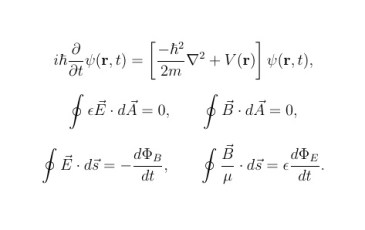
This is one of the most beautiful results in all of physics, and I find it astonishing that at no point in my decade as a student was it presented or even mentioned. Typically, a formal introduction to the wavefunction and the Schrödinger equation is encountered at a senior undergraduate level. The fact that an … More How Electromagnetism Arises from Local Gauge Symmetry in Quantum Mechanics

More Thoughts on Bird Names and Barriers

Edit: Please sign the petition here: https://chng.it/srvVNZ5mSZ The image above pictures Sir Chandrasekhara Venkata Raman. He was a brilliant physicist whose work helps us understand how blue feathers get their color, among many other things. His name is attached to concepts such as Raman scattering and Raman spectroscopy. The natural world overflows with an abundance … More More Thoughts on Bird Names and Barriers

Some Thoughts on Bird Names and Barriers

Edit: New as of late June, 2024: Unlike the AOS, the AFO actually surveys its members: https://afonet.org/2024/06/afo-member-feedback-on-the-decision-from-aos-to-replace-all-eponymous-bird-names/ I post this with trepidation. I am disinclined to touch on such topics here. A few years ago, I became involved with a birding organization whose core mission of making birding more accessible deeply resonated with me. I … More Some Thoughts on Bird Names and Barriers

The Physics of Parabolic Microphones: Frequency Dependence of Gain

Introduction Parabolic microphones are known for their extreme sensitivity, and the origin of their acuity isn’t difficult to guess. It is the most obvious thing about them, which can also make them a liability for field use, namely, their considerable size. Just as a large amount of weak light is captured by a telescope’s parabolic … More The Physics of Parabolic Microphones: Frequency Dependence of Gain

The Physics of Roof Prisms and Phase Coatings, Simplified: Part III

Diffraction patterns and resolution In the previous post we traced the passage of light through an Amici roof prism, which required decomposing vectors into components, accounting for phase shifts upon reflection, and then looking at how the waves will be recombined. We can now see that there will be an opportunity for interference effects to … More The Physics of Roof Prisms and Phase Coatings, Simplified: Part III

The Physics of Roof Prisms and Phase Coatings, Simplified: Part II

Phase shifts and interference The previous post introduced the topic of roof prism performance loss resulting from phase shifts that accompany total internal reflection (TIR). These shifts are endemic to TIR and to any device that employs it, including not only roof but Porro prisms. But in the latter case, the shifts have no deleterious … More The Physics of Roof Prisms and Phase Coatings, Simplified: Part II